

Showing posts with label prevention. Show all posts
Showing posts with label prevention. Show all posts
How to Handle Major Change
The old adage, “the only constant in life is change,” may be trite but it’s true. One of the greatest gifts one can receive while going through major change is the gift of perspective. Perspective isn’t just “maintain a positive attitude.” Perspective can be achieved by acknowledging what is going well in your life even while things are in upheaval. Daily gratitude has also been proven to change the chemistry of the brain for the better, and is another tool to give perspective. Perspective can also be achieved when we're in the constant pursuit of knowledge, self-education, and learning new skills. Sometimes when major change or even multiple major changes come our way, it’s tempting to think “why is this happening to me?” But I would challenge you to reframe and choose the mindset that everything is not happening for me and not to me. You might not get to choose what life throws your way but you can choose how you respond, search for a lesson to be learned, and work to make meaning from the difficult change or changes you are going through.

Serving Others is Self-Serving…and That’s a Good Thing
In 2016, a study was published in Psychosomatic Medicine: Journal of Biobehavioral Medicine that found that giving had greater benefits than receiving (yes, The Office fans; that’s what she said). The results from participants in the study showed that giving (and not receiving) reduced stress related activities in the brain and reduced vulnerability for negative psychosocial outcomes. Put simply, the study showed that when you help others you’re also helping yourself.
Outside the context of the study and from my own research as well as through lived experience, I’ve found that helping others is a great way to boost self-esteem, self-confidence, and self-worth. Helping others is a useful way to create connectivity, to find purpose in your life, and if you choose, to make meaning of the mundane or of something difficult or traumatic.
Outside the context of the study and from my own research as well as through lived experience, I’ve found that helping others is a great way to boost self-esteem, self-confidence, and self-worth. Helping others is a useful way to create connectivity, to find purpose in your life, and if you choose, to make meaning of the mundane or of something difficult or traumatic.
It almost seems counterintuitive to help someone else when you need help but even the seemingly smallest action can have a massive positive affect on the person being helped as well as on your state of mind. By getting our of your own head (temporarily) and shifting focus away from your difficulty or problem you’re facing, you’re distracting yourself from the potential of a self-inflicted negative feedback loop. You do something nice for someone and that feels good but you also gain a little perspective as well (the mountain you thought you were dealing with is actually an obnoxious mole hill).
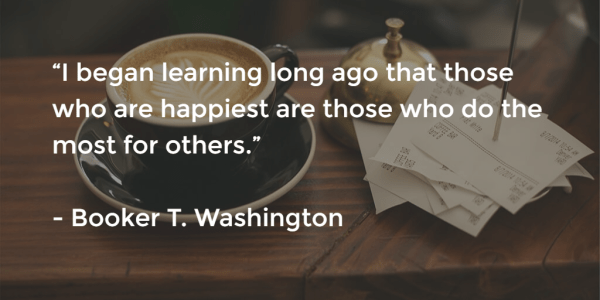 There are lots of ways you can help people or groups of people. One overlooked method of help is to show another person compassion—for their mistakes, their slights (whether intentional or unintentional) toward you, for their uniqueness and vulnerability that might not line up with your own values or preferences. Compassion brings understanding, which then brings about connectivity (with varying degrees of elasticity, of course).
Another overlooked form of helping others is actually practicing self-love and self-care. By loving yourself, treating yourself well, and setting healthy boundaries, you’re ensuring that when you decide to begin or resume helping others you’re doing so as close to peak performance as possible.
By looking after others, you’re actually looking after your mental health and nutrition.
Another overlooked form of helping others is actually practicing self-love and self-care. By loving yourself, treating yourself well, and setting healthy boundaries, you’re ensuring that when you decide to begin or resume helping others you’re doing so as close to peak performance as possible.
By looking after others, you’re actually looking after your mental health and nutrition.
Energetic Activities: A Major “Food Group” For Mental Nutrition
When exercising or doing things that involve any level of physical activity, the real or perceived impact of the activity is almost always measured with a focus on the external.
However, the impact of energetic activities (or at times, lack thereof) is not often enough measured in an improvement in how one is feeling, the quality of their thought life, and how it can help provide healthy balance, perspective, and energy to one’s daily life.
Energetic activities can and should be one of six core, major groups that form one’s mental nutrition pyramid.

Energetic activities have been proven reduce anxiety and depression, and improve mood and one’s motivation. It improves cardiovascular function (ain’t nobody got time for heart disease), and can mitigate the effects of stress.
Energetic activities aren’t only “gym” activities; they can include: stretching, laughing, walking, sex, playing outside, building things, or anything that increases your heart rate to beat a bit more rapidly.
Simple lifestyle modifications can help you engage in more energetic activities. This can include taking one flight of stairs instead of the elevator or walking through the airport instead of standing still on the people mover (the horizontal escalator thingy).
We need to be intentional about our energetic activities so that when we get busy or when something comes up, we don’t push our preferred energetic activities to the side.
Schedule your activity or activities in your calendar or put up a post it note on your bathroom mirror—there are so many ways to find and make time. You can add it to a vision board or create a visual system where you keep track of how often you meet your energetic activities goals and then reward yourself at certain points during your progress.
Start out small if you must. Incremental changes make the biggest differences over a long period of time. Rather than trying to run twenty miles per week, how about twenty minutes? If you want to increase time or distance at some point, then go for it but the most important part is first creating healthy habits (that goes for any one of the six core groups of your mental nutrition) and then becoming aware of what benefits these new habits have on your life. If you miss your mark or lose steam, that’s okay. You’re a human being and you’re trying your best. Your main goal is not a specific number or to beat a time or to weigh a certain amount; it’s to create the healthiest, happiest, most well-adjusted version of you as possible.
- The loss of weight or lowering one’s BMI
- How much faster you were able to do said activity
- How one looks as a result (thinner or more muscular or more toned)
- Rosier cheeks
- Looking healthier
However, the impact of energetic activities (or at times, lack thereof) is not often enough measured in an improvement in how one is feeling, the quality of their thought life, and how it can help provide healthy balance, perspective, and energy to one’s daily life.
Energetic activities can and should be one of six core, major groups that form one’s mental nutrition pyramid.
Energetic activities have been proven reduce anxiety and depression, and improve mood and one’s motivation. It improves cardiovascular function (ain’t nobody got time for heart disease), and can mitigate the effects of stress.
Energetic activities aren’t only “gym” activities; they can include: stretching, laughing, walking, sex, playing outside, building things, or anything that increases your heart rate to beat a bit more rapidly.
Simple lifestyle modifications can help you engage in more energetic activities. This can include taking one flight of stairs instead of the elevator or walking through the airport instead of standing still on the people mover (the horizontal escalator thingy).
We need to be intentional about our energetic activities so that when we get busy or when something comes up, we don’t push our preferred energetic activities to the side.
Schedule your activity or activities in your calendar or put up a post it note on your bathroom mirror—there are so many ways to find and make time. You can add it to a vision board or create a visual system where you keep track of how often you meet your energetic activities goals and then reward yourself at certain points during your progress.
Start out small if you must. Incremental changes make the biggest differences over a long period of time. Rather than trying to run twenty miles per week, how about twenty minutes? If you want to increase time or distance at some point, then go for it but the most important part is first creating healthy habits (that goes for any one of the six core groups of your mental nutrition) and then becoming aware of what benefits these new habits have on your life. If you miss your mark or lose steam, that’s okay. You’re a human being and you’re trying your best. Your main goal is not a specific number or to beat a time or to weigh a certain amount; it’s to create the healthiest, happiest, most well-adjusted version of you as possible.
What is Mental Nutrition?
Put simply it’s the fuel we feed our brains in order to have a well-adjusted and healthy life. Paying attention to our mental nutrition helps us manage our emotions, deepen our empathy, create a toolkit to handle adversity and unplanned crisis, as well as to deepen our fulfillment of the day to day.
Mental nutrition is partly interchangeable for mental health; and we as a society are so afraid to mention it or even say the words mental health, as if they’re dirty words and someone else’s problem or for those “unhinged” and seemingly unproductive members of society. The hell it is.
The functioning of your brain, healthy or unhealthy, isn’t “all in your head,” as if you’re making things up, just like if you have lung cancer, it’s not just “all in your lungs.” Mental health is a brain event and very real just like lung cancer is a lung event and very real.

We must not bury our heads in the sand or be fearful of opening Pandora’s Box if we start learning about and taking care of our mental nutrition. The healthier our brain, the more fulfilling and productive and happy our life will be. We must be intentional about taking care of our mental nutrition.
Mental nutrition is important for the individual. For the team leader. For the manager. For the corporation. For the system and for the collective.
It starts with me. It starts with you. It starts with us…together.
Mental nutrition is partly interchangeable for mental health; and we as a society are so afraid to mention it or even say the words mental health, as if they’re dirty words and someone else’s problem or for those “unhinged” and seemingly unproductive members of society. The hell it is.
The functioning of your brain, healthy or unhealthy, isn’t “all in your head,” as if you’re making things up, just like if you have lung cancer, it’s not just “all in your lungs.” Mental health is a brain event and very real just like lung cancer is a lung event and very real.
We must not bury our heads in the sand or be fearful of opening Pandora’s Box if we start learning about and taking care of our mental nutrition. The healthier our brain, the more fulfilling and productive and happy our life will be. We must be intentional about taking care of our mental nutrition.
Mental nutrition is important for the individual. For the team leader. For the manager. For the corporation. For the system and for the collective.
It starts with me. It starts with you. It starts with us…together.
How to Support a Colleague Going through a Difficult Time
Helping and holding space with a colleague while going through a difficult time can be incredibly confusing. People are often reticent to be around someone going through a difficult time because they don’t know what to say or are afraid to say the wrong thing.

But the best way to help a person going through a difficult time is to simply go to that person, in a private and respectful place, of course, and first acknowledge that they are going through a difficult time. Then validate what they are going through by saying things like:
- “that must be difficult,”
- “I feel for you,” or
- “you’re brave…”
…as long as it comes from a genuine and caring place.
Then ask them if they want to talk about it or if they want advice or if they want to scream or cry or take a walk to let off steam. You don’t have to have all the answers and you won’t be able to fix their problem.
Try not to say things like:
- “I feel bad for you.” No one wants pity. People would much rather have empathy; so the phrase “I feel bad for you,” becomes, “I feel for you.”
- “It's going to get better,” because you can’t keep that promise nor can you actually predict when it’s going to get better. Instead, you can say, “it’ll get different,” because that is a promise you can keep. Life is full of ups and downs; it will get better, not so good, and then better again.
- “I know how you feel” because you don’t. Just be there and be present.
Simply giving them the space to express themselves goes a long way in helping that colleague going through a hard time.
How to Reframe your Thinking to Get a Better Outcome
So you want a better outcome on whatever you're looking to achieve. In order to work toward a better outcome you must acknowledge that the current outcome is not an end point but rather a lesson on the way to success. We often have some idea of what we want an outcome to look like and then act on what we perceive to be the first steps toward achieving it. But instead of doing that, identify how you want to feel after you’ve achieved that outcome and then trace your steps backwards from the end point all the way to the beginning.

Rehearse in your head and out loud what a successful outcome would look and feel like. Use past experiences of success to inform this.
- What did the success feel, look, and sound like?
- How did you handle it?
- Had you experienced any other successes prior to the occurrence you’re thinking of and if so, can you dig deep and analyze to find patterns that led to each of those successes?
If you do find a pattern, you can use it to inform the actions you take while you’re working toward achieving this new goal.
One thing to note here: don’t fall into the trap of becoming attached to the outcome you’ve created in your rehearsals. And don’t fall into the trap of only relying on actions from past successes to inform future successes. You’re essentially practicing only so you can train your brain to be more accustomed to what success feels like and can then make it more of a habit.I have no doubt that by taking any or all of these actions, you will be on the path toward a better outcome in no time.
Subscribe to:
Posts (Atom)