

Showing posts with label coping. Show all posts
Showing posts with label coping. Show all posts
How to Handle Major Change
The old adage, “the only constant in life is change,” may be trite but it’s true. One of the greatest gifts one can receive while going through major change is the gift of perspective. Perspective isn’t just “maintain a positive attitude.” Perspective can be achieved by acknowledging what is going well in your life even while things are in upheaval. Daily gratitude has also been proven to change the chemistry of the brain for the better, and is another tool to give perspective. Perspective can also be achieved when we're in the constant pursuit of knowledge, self-education, and learning new skills. Sometimes when major change or even multiple major changes come our way, it’s tempting to think “why is this happening to me?” But I would challenge you to reframe and choose the mindset that everything is not happening for me and not to me. You might not get to choose what life throws your way but you can choose how you respond, search for a lesson to be learned, and work to make meaning from the difficult change or changes you are going through.

Serving Others is Self-Serving…and That’s a Good Thing
In 2016, a study was published in Psychosomatic Medicine: Journal of Biobehavioral Medicine that found that giving had greater benefits than receiving (yes, The Office fans; that’s what she said). The results from participants in the study showed that giving (and not receiving) reduced stress related activities in the brain and reduced vulnerability for negative psychosocial outcomes. Put simply, the study showed that when you help others you’re also helping yourself.
Outside the context of the study and from my own research as well as through lived experience, I’ve found that helping others is a great way to boost self-esteem, self-confidence, and self-worth. Helping others is a useful way to create connectivity, to find purpose in your life, and if you choose, to make meaning of the mundane or of something difficult or traumatic.
Outside the context of the study and from my own research as well as through lived experience, I’ve found that helping others is a great way to boost self-esteem, self-confidence, and self-worth. Helping others is a useful way to create connectivity, to find purpose in your life, and if you choose, to make meaning of the mundane or of something difficult or traumatic.
It almost seems counterintuitive to help someone else when you need help but even the seemingly smallest action can have a massive positive affect on the person being helped as well as on your state of mind. By getting our of your own head (temporarily) and shifting focus away from your difficulty or problem you’re facing, you’re distracting yourself from the potential of a self-inflicted negative feedback loop. You do something nice for someone and that feels good but you also gain a little perspective as well (the mountain you thought you were dealing with is actually an obnoxious mole hill).
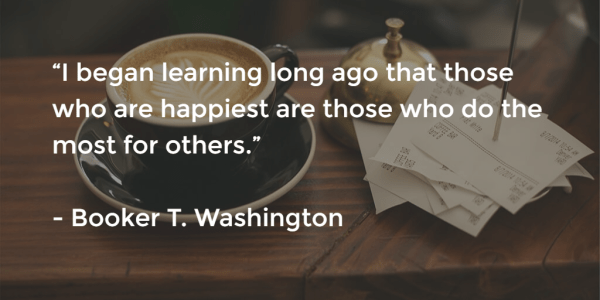 There are lots of ways you can help people or groups of people. One overlooked method of help is to show another person compassion—for their mistakes, their slights (whether intentional or unintentional) toward you, for their uniqueness and vulnerability that might not line up with your own values or preferences. Compassion brings understanding, which then brings about connectivity (with varying degrees of elasticity, of course).
Another overlooked form of helping others is actually practicing self-love and self-care. By loving yourself, treating yourself well, and setting healthy boundaries, you’re ensuring that when you decide to begin or resume helping others you’re doing so as close to peak performance as possible.
By looking after others, you’re actually looking after your mental health and nutrition.
Another overlooked form of helping others is actually practicing self-love and self-care. By loving yourself, treating yourself well, and setting healthy boundaries, you’re ensuring that when you decide to begin or resume helping others you’re doing so as close to peak performance as possible.
By looking after others, you’re actually looking after your mental health and nutrition.
Self-Reflection for Mental Nutrition: Bringing Order to Disorder
“Our self-image, strongly held, essentially determines what we become.”
- Maxwell Maltz
Self-image and self-esteem are strongly influenced by the kind and quality of thoughts we have about ourselves and how we reflect, appraise, and evaluate ourselves.
Self-reflection leads to self-awareness, which is a key element to developing leadership (self-directed or a leader of others), maturity, and emotional intelligence.
Being able to self-reflect in a healthy and productive manner is important, but carving out time to do so is where things can get tricky. Long-held theory states that self-reflection occupies roughly 50% of our waking life. However, self-reflection can happen unintentionally and one can be unaware of how they are analyzing and assessing themselves; this is a more inefficient manner of reflection because it can often lead to poor planning and flawed decision making.
Intentional self-reflection is much more efficient because we can analyze and assess “self” with more objective thinking and more easily seek outside solutions and help for whatever refinement or improvement we feel needs to occur in our lives.
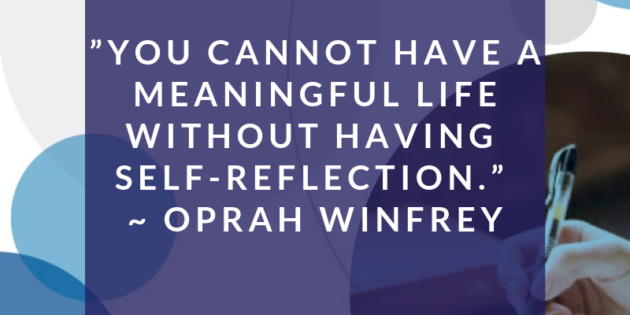
Many avoid and forgo self-reflection though avoidance—running from “self” through any sort of excessive activity (fill in the blank with: alcohol or other substances, food, church, sex, caregiving). Why would someone not want to engage in self-reflection? Fear is likely a motivating factor—fear of what you might uncover, fear of the unknown, fear of confrontation, fear of the potential of opening old wounds, fear of taking accountability, or fear of not being “good enough.”
Taking the time to reflect on self allows you to slow down amidst the busy-ness or chaos of life. It can help you bring some order to the disorder. If you’re a go-getter or feel the need to constantly be moving, self-reflection allows you to pause and recalibrate so that your future actions are more effective and efficient. When first becoming intentional about self-reflection it can be uncomfortable, you might not know how to go about it, or what you uncover might be painful. But intentionally reflecting on self over a period of time can lead to a sense of clarity on one’s direction in life as well as inner peace.
Some important questions to ask yourself when engaging in self-reflection:
- What can I improve upon in my life, by even a small percentage?
- What am I avoiding?
- How can I be more effective in my relationships?
- How can I love or care for myself (at all or even more than now)?
- What am I grateful for?
- Am I viewing my current circumstances with a healthy perspective?
- What do I need help with currently and what is keeping me from asking for help?
- Morning pages
- Constructive feedback
- Creating a personal manifesto
- Vision board
- Counseling therapy
- Monitoring your inner dialogue
- Personality tests
Creating a Mental Nutrition Plan
Many of us are familiar with a nutrition plan that involves food and exercise. But not nearly as many are familiar with the idea of creating a nutrition plan for the health of your brain and mental state. If you want your brain and your life to be running at peak performance, then it’s a good idea to create a mental nutrition plan for yourself. And think about it much like the food pyramid that was so popular back in the 1980s and 90s. There are 6 major mental nutrition “food groups.”

- Things you consume which can include food, supplements, alcohol, drugs.
- Relaxation activities or self-care.
- Reflection.
- Energetic activities or exercise.
- Service based activities.
- Your support system.
After creating your mental nutrition plan, check in with it and check in with yourself on a weekly basis. What part of the plan were you consistent with and how are you feeling based on the actions you took? If you need to adjust and find that you need to spend 10% more time on self-care and 5% less time on reflection during the week then go for it. And be gentle with yourself—like a food nutrition plan, you’re allowed to have junk food once in awhile and some plans involve cheat days. Don’t go overboard with the metaphorical junk food but keep an eye on it.
You've heard that you are what you eat; well you are what you feed your brain too. Mental nutrition is important, it matters, and so do you.
You've heard that you are what you eat; well you are what you feed your brain too. Mental nutrition is important, it matters, and so do you.
Energetic Activities: A Major “Food Group” For Mental Nutrition
When exercising or doing things that involve any level of physical activity, the real or perceived impact of the activity is almost always measured with a focus on the external.
However, the impact of energetic activities (or at times, lack thereof) is not often enough measured in an improvement in how one is feeling, the quality of their thought life, and how it can help provide healthy balance, perspective, and energy to one’s daily life.
Energetic activities can and should be one of six core, major groups that form one’s mental nutrition pyramid.

Energetic activities have been proven reduce anxiety and depression, and improve mood and one’s motivation. It improves cardiovascular function (ain’t nobody got time for heart disease), and can mitigate the effects of stress.
Energetic activities aren’t only “gym” activities; they can include: stretching, laughing, walking, sex, playing outside, building things, or anything that increases your heart rate to beat a bit more rapidly.
Simple lifestyle modifications can help you engage in more energetic activities. This can include taking one flight of stairs instead of the elevator or walking through the airport instead of standing still on the people mover (the horizontal escalator thingy).
We need to be intentional about our energetic activities so that when we get busy or when something comes up, we don’t push our preferred energetic activities to the side.
Schedule your activity or activities in your calendar or put up a post it note on your bathroom mirror—there are so many ways to find and make time. You can add it to a vision board or create a visual system where you keep track of how often you meet your energetic activities goals and then reward yourself at certain points during your progress.
Start out small if you must. Incremental changes make the biggest differences over a long period of time. Rather than trying to run twenty miles per week, how about twenty minutes? If you want to increase time or distance at some point, then go for it but the most important part is first creating healthy habits (that goes for any one of the six core groups of your mental nutrition) and then becoming aware of what benefits these new habits have on your life. If you miss your mark or lose steam, that’s okay. You’re a human being and you’re trying your best. Your main goal is not a specific number or to beat a time or to weigh a certain amount; it’s to create the healthiest, happiest, most well-adjusted version of you as possible.
- The loss of weight or lowering one’s BMI
- How much faster you were able to do said activity
- How one looks as a result (thinner or more muscular or more toned)
- Rosier cheeks
- Looking healthier
However, the impact of energetic activities (or at times, lack thereof) is not often enough measured in an improvement in how one is feeling, the quality of their thought life, and how it can help provide healthy balance, perspective, and energy to one’s daily life.
Energetic activities can and should be one of six core, major groups that form one’s mental nutrition pyramid.
Energetic activities have been proven reduce anxiety and depression, and improve mood and one’s motivation. It improves cardiovascular function (ain’t nobody got time for heart disease), and can mitigate the effects of stress.
Energetic activities aren’t only “gym” activities; they can include: stretching, laughing, walking, sex, playing outside, building things, or anything that increases your heart rate to beat a bit more rapidly.
Simple lifestyle modifications can help you engage in more energetic activities. This can include taking one flight of stairs instead of the elevator or walking through the airport instead of standing still on the people mover (the horizontal escalator thingy).
We need to be intentional about our energetic activities so that when we get busy or when something comes up, we don’t push our preferred energetic activities to the side.
Schedule your activity or activities in your calendar or put up a post it note on your bathroom mirror—there are so many ways to find and make time. You can add it to a vision board or create a visual system where you keep track of how often you meet your energetic activities goals and then reward yourself at certain points during your progress.
Start out small if you must. Incremental changes make the biggest differences over a long period of time. Rather than trying to run twenty miles per week, how about twenty minutes? If you want to increase time or distance at some point, then go for it but the most important part is first creating healthy habits (that goes for any one of the six core groups of your mental nutrition) and then becoming aware of what benefits these new habits have on your life. If you miss your mark or lose steam, that’s okay. You’re a human being and you’re trying your best. Your main goal is not a specific number or to beat a time or to weigh a certain amount; it’s to create the healthiest, happiest, most well-adjusted version of you as possible.
How to Effectively Deal with Difficulty or Failure
This is about retraining the brain. Instead of asking why this is happening to you; CHOOSE to acknowledge that everything is happening FOR you and not TO you. This is the first step in leading toward a more solutions-based mindset that will then lead you away from the thing that isn’t working and toward your vision of what “success” looks like.
You can of course, take time to mourn the failure or thing that didn't work, but at some point soon after take time to reflect on what you can learn from the failure and how you can pivot and eventually turn that loss into a win. Everything happens for a reason but only if you choose that mindset.

Take responsibility if it's required and be vulnerable with the person, persons, or entity who was affected by the failure. If it’s appropriate, express that you wish to work toward a more successful outcome and ask for feedback and assistance if necessary.
And don’t forget to forgive yourself. You are a human being and doing the best you can with the information you have at the moment.
Lean into failure—own it, wrestle with it, and learn from it. Failing doesn’t make you a failure, it simply allows you to move closer toward success. You’ve bounced back before and you’ll do it again.
You can of course, take time to mourn the failure or thing that didn't work, but at some point soon after take time to reflect on what you can learn from the failure and how you can pivot and eventually turn that loss into a win. Everything happens for a reason but only if you choose that mindset.
Take a look at your coping skills and mechanisms. Avoiding dealing with the failure or numbing the pain with alcohol or substances or excessive anything is not a solution and will only prolong the pain and might even make the effects of the failure worse. Instead, go back to reframing the failure as a lesson and find ways to cope by taking care of your physical and mental wellness.
Take responsibility if it's required and be vulnerable with the person, persons, or entity who was affected by the failure. If it’s appropriate, express that you wish to work toward a more successful outcome and ask for feedback and assistance if necessary.
And don’t forget to forgive yourself. You are a human being and doing the best you can with the information you have at the moment.
Lean into failure—own it, wrestle with it, and learn from it. Failing doesn’t make you a failure, it simply allows you to move closer toward success. You’ve bounced back before and you’ll do it again.
Subscribe to:
Posts (Atom)